Artichoke
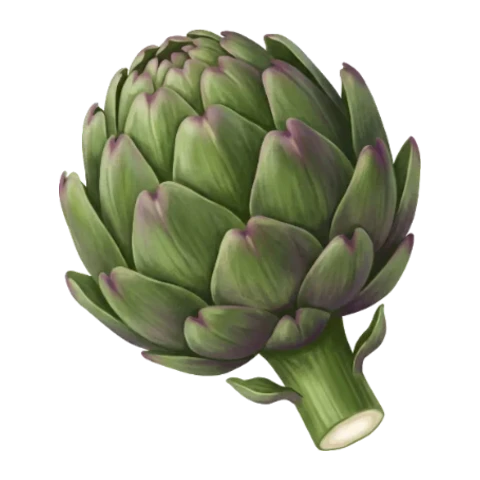
A big flower bud eaten before it opens; Brittany is France’s top producer.
- Season: May, June, July, August, September, October
- Peak season: June, July
- Botanical family: Asteraceae
History
The artichoke was bred in Sicily and southern Italy from wild cardoon. Catherine de’ Medici brought it to the French court in the 16th century and adored it. Brittany then made it a great speciality thanks to its mild climate.
Origin and growing regions
France is Europe’s second-largest artichoke producer:
- Brittany (Léon)
- Provence-Alpes-Côte d’Azur
- Occitanie (Roussillon)
Brittany artichokes are an emblem of the “Golden Belt” on the Finistère coast.
Benefits
The artichoke is light and very rich in fibre:
- Fibre: Including inulin, good for gut flora.
- Very low in calories: About 45 kcal/100 g.
- Potassium: Helps fluid balance.
- Cynarin: Traditionally linked to digestion.
Varieties
- Camus de Bretagne: Big and round, the most common.
- Violet de Provence: Elongated, can be eaten raw.
- Small poivrade: Small and tender, eaten raw.
- Castel: Early Breton variety.
Zero waste
- Storing: Stem in a glass of water, somewhere cool: 3 to 4 days.
- Freezing: Cooked hearts with lemon: up to 12 months.
- Nothing goes to waste: The cooking water makes a stock. The peeled stem is as good as the heart.