Asparagus
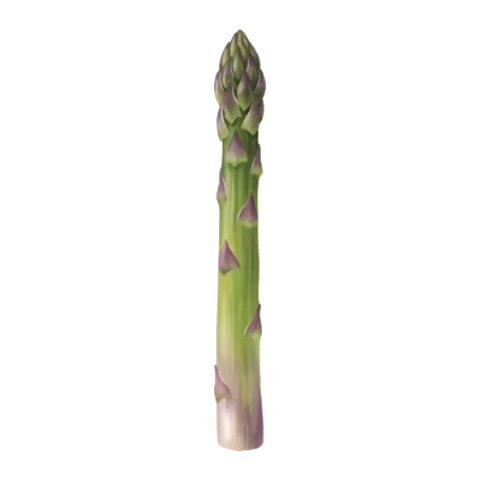
A tender spring shoot: white, green or purple depending on how much sun it saw.
- Season: April, May, June
- Peak season: May
- Botanical family: Asparagaceae
History
The Egyptians and Romans already grew asparagus, prized for its delicacy and medicinal virtues. It became a luxury vegetable at the court of Louis XIV, who had it grown in greenhouses at Versailles even in winter. In the 19th century, the Argenteuil area near Paris made it its speciality.
Origin and growing regions
French asparagus grows mainly in light, sandy soils that make earthing-up easy:
- Centre-Val de Loire (Sologne)
- Nouvelle-Aquitaine (Landes)
- Alsace
- Provence-Alpes-Côte d’Azur
Landes sand asparagus has a PGI.
Benefits
Asparagus is light and full of good things:
- Very low in calories: About 25 kcal/100 g.
- Vitamin B9: One of the best plant sources.
- Fibre: Including inulin, good for gut flora.
- Potassium: Helps muscles work properly.
Varieties
- White: Harvested underground, mild and melting.
- Green: Grown in the sun, stronger taste, no need to peel.
- Purple: Coloured tip, slightly fruity.
- Wild: Very thin, picked in spring in the south.
Zero waste
- Storing: Standing in a glass of water in the fridge, or wrapped in a damp tea towel: 3 days.
- Freezing: Peeled and blanched for 2 min: up to 8 months.
- Nothing goes to waste: Peelings and woody ends make a lovely soup or stock.