Squash
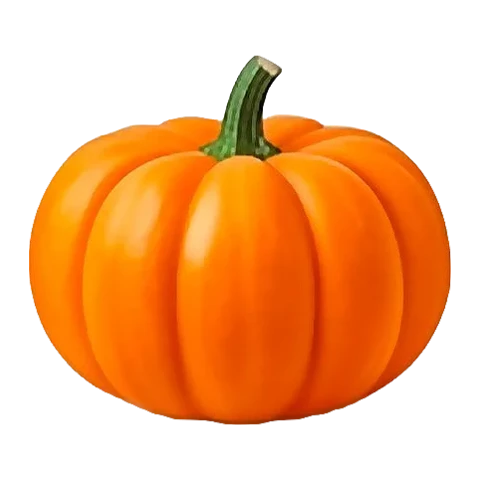
Keeps for months somewhere dry; perfect in soup.
- Season: September, October, November, December, January
- Peak season: October, November
- Botanical family: Cucurbitaceae
History
Native to South America, the winter squash was among the squashes brought to Europe in the 16th century. It found a place in vegetable gardens for its hardiness and long shelf life. It is often confused with the pumpkin, a related species made famous by Halloween.
Origin and growing regions
French winter squash is grown in the west and centre:
- Pays de la Loire
- Centre-Val de Loire
- Nouvelle-Aquitaine
Rouge vif d’Étampes is a much-loved old French variety.
Benefits
Winter squash is mild, light and colourful:
- Beta-carotene: Its orange flesh is very rich in it.
- Low in calories: About 25 kcal per 100 g.
- Gentle fibre: Perfect in soup and easy to digest.
- Potassium: Helps fluid balance.
Varieties
- Rouge vif d’Étampes: Big and ribbed, the Halloween star.
- Red kuri: Chestnut taste, edible skin.
- Blue Hungarian: Grey-blue rind, sweet orange flesh.
- Galeux d’Eysines: Covered in little bumps, melting flesh.
- Turban squash: Turban-shaped, floury flesh.
Zero waste
- Storing: Whole, somewhere dry and cool: several months. Once cut, in the fridge, wrapped: 1 week.
- Freezing: In raw cubes or as purée: up to 12 months.
- Nothing goes to waste: The seeds can be roasted in the oven with salt. Red kuri squash skin is edible, no need to peel it.